
ALMATY – As more than 500 high school students from 106 countries gathered in Astana for the International Olympiad in Artificial Intelligence (IOAI), President Kassym-Jomart Tokayev used the event to showcase Kazakhstan’s broader ambition to become one of Eurasia’s leading AI economies. But while hosting global competitions highlights the country’s growing digital profile, experts say long-term success will depend less on attracting talent than on creating an ecosystem capable of retaining it, commercializing research and translating education into innovation.
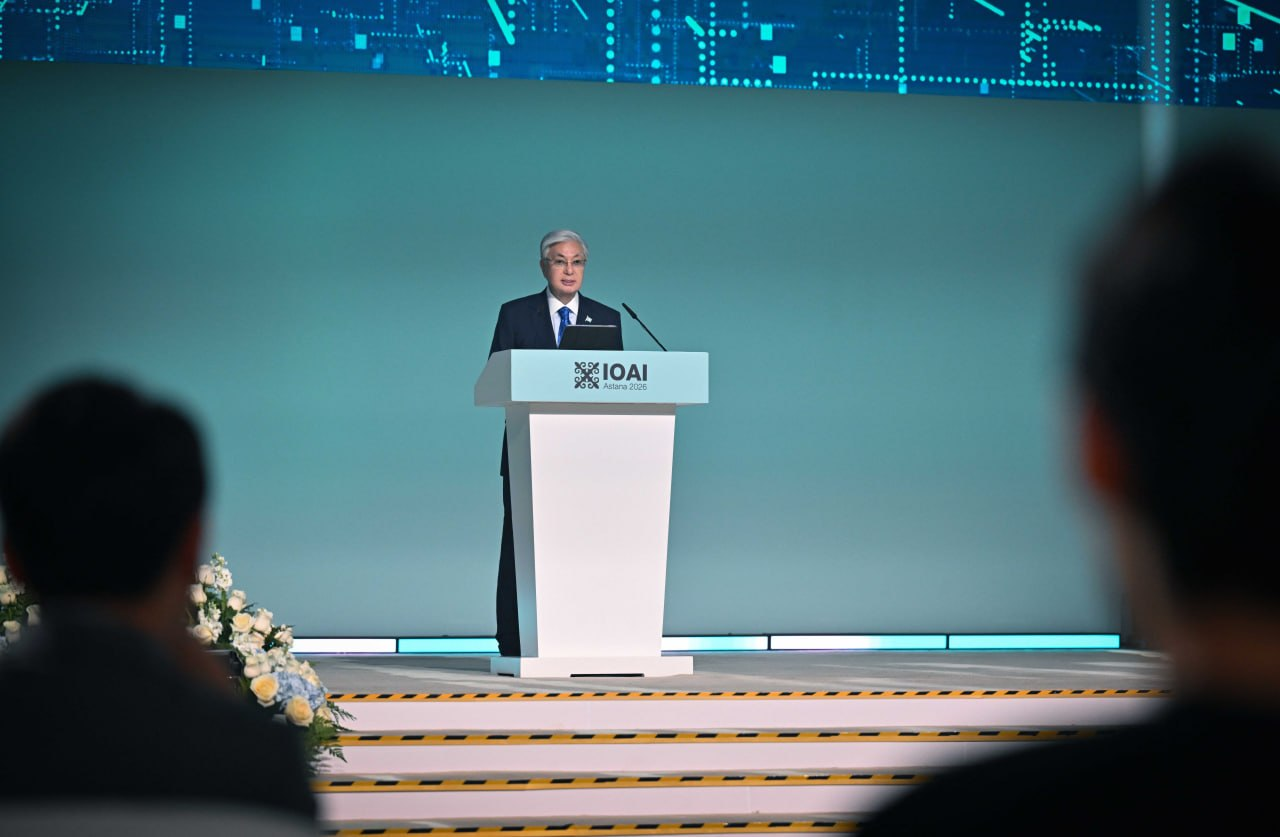
Speaking at the opening ceremony of the Olympiad, which runs from Aug. 2 to 8, Tokayev described artificial intelligence as one of the central pillars of Kazakhstan’s long-term development strategy. Photo credit: Akorda.
Speaking at the opening ceremony of the Olympiad, which runs from Aug. 2 to 8, Tokayev described artificial intelligence as one of the central pillars of Kazakhstan’s long-term development strategy.
President Tokayev also said that Kazakhstan has made a “strategic choice” in favor of digital transformation, pointing to the country’s ranking of 24th in the United Nations E-Government Development Index and its position as Central Asia’s leader in technological readiness.
“We are creating a unified innovative ecosystem in which artificial intelligence serves as an important tool for managing the state, economy, and business, permeating all areas of public life,” Tokayev said.
AI is indeed becoming an essential tool for government, business and public services as Kazakhstan works toward becoming a fully digital state within three years. The designation of 2026 as the Year of Digitalization and Artificial Intelligence and the inclusion of innovation in the country’s new Constitution are intended to accelerate that transition.
The IOAI, however, reflects a broader objective than technological modernization alone. As one of the newest international science olympiads, established in 2024, the competition seeks not only to identify talented students but also to create an international community of future AI researchers while encouraging discussion about the opportunities and ethical challenges posed by artificial intelligence.
Kazakhstan was among the founding members of the Olympiad and became the first Central Asian country to host the event.
Building an AI pipeline
The country’s AI strategy increasingly spans the entire talent pipeline from schools to research infrastructure and commercial applications. Last year, Kazakhstan’s team won three gold, one silver and three bronze medals at the Olympiad in Beijing, a result Tokayev said demonstrated the country’s growing pool of young scientific talent.
Kazakhstan’s Competitive Programming Federation President Bagdat Mussin argued that such achievements should complement rather than replace higher education.
“Computer science, programming and artificial intelligence are becoming essential skills for anyone planning to build a career. But deep expertise in physics, chemistry, biology and other disciplines remains equally important,” Mussin told the Kazinform news agency on the sidelines of the Olympiad.
His comments reflect a growing recognition that AI education increasingly extends beyond computer science itself, becoming a tool across multiple industries.
That approach is already shaping government policy. Kazakhstan has introduced artificial intelligence into university curricula and launched a national goal of training one million people in AI skills over the next five years, targeting students, civil servants, businesses and the broader workforce.
Infrastructure to match ambition
Education is only one component of Kazakhstan’s AI strategy. In recent months, the government has accelerated investments in digital infrastructure, commissioning Central Asia’s first advanced AI supercomputers, expanding satellite internet coverage through OneWeb and Starlink, signing agreements with Amazon’s Project Kuiper, and opening the International Center for Artificial Intelligence.
The country has also positioned itself more actively within global AI governance, becoming a founding member of the World Artificial Intelligence Cooperation Organization (WAICO), while securing major partnerships with NVIDIA and U.S.-based AI infrastructure company Firebird to develop large-scale computing infrastructure.
Together, these initiatives suggest Kazakhstan is attempting to build the foundations of an AI ecosystem rather than focusing solely on individual projects.
From digitalization to innovation
The broader question, however, is whether these investments can generate sustained innovation. As Indian Ambassador to Kazakhstan Y. K. Sailas Thangal noted in an earlier opinion article, artificial intelligence should be viewed not as an end in itself but as a tool capable of transforming healthcare, education, governance, agriculture and urban development when implemented responsibly.
That perspective aligns with Kazakhstan’s own strategy, which increasingly frames AI as an economy-wide technology rather than a standalone sector. Yet international experience suggests that building AI leadership requires more than digital infrastructure or educational reforms. Successful ecosystems typically depend on strong research universities, private investment, startup financing, commercialization pathways and the ability to retain highly skilled graduates.
Hosting an international Olympiad can raise a country’s profile. Turning that visibility into innovation, however, requires institutions capable of supporting talent long after the competition ends.
For Kazakhstan, the olympiad offers an opportunity to demonstrate how the country’s expanding investments in education, computing infrastructure and international partnerships fit into a broader national strategy.
