
ASTANA – This week’s election campaign roundup covers developments from July 27 to Aug. 2, when Kazakhstan’s political parties intensified voter outreach following the first nationally televised debate and held dozens of campaign events nationwide.
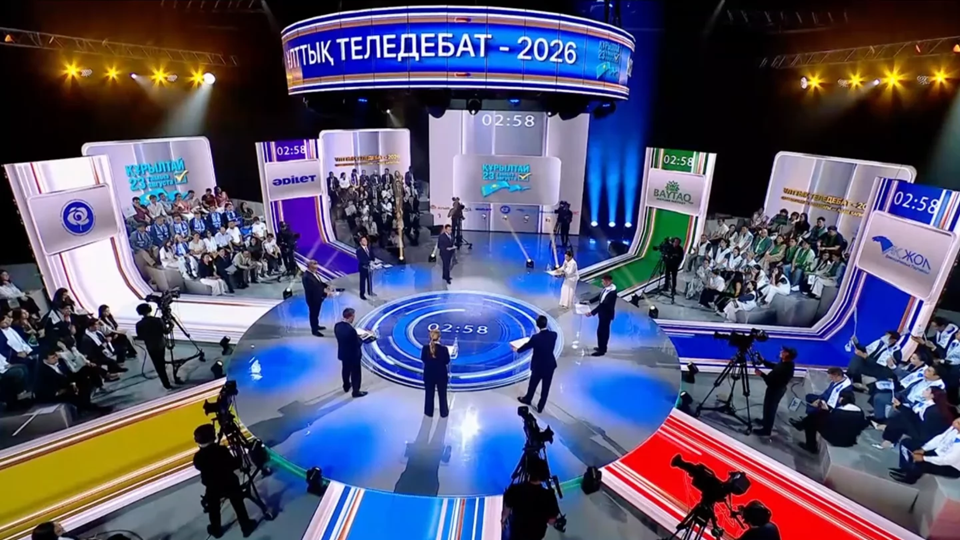
A still from Qazaqstan TV’s broadcast of the first national televised debate among parties competing in Kazakhstan’s Kurultai elections. Photo credit: qazaqstan.tv
National televised debate draws public attention
One of the week’s key campaign events took place on July 29, when Qazaqstan TV hosted the first round of the national televised debates featuring representatives of the seven parties contesting the Kurultai elections.
The debate opened with two-minute statements from each party outlining why they are seeking seats in the Kurultai and presenting the main priorities of their election platforms. The second segment featured two common policy questions posed to all participants, while the final round adopted a face-to-face format, allowing party representatives to question one another.
According to preliminary results based on 15,876 online votes, Adilet received 66.1% support, followed by the Aq Jol Democratic Party with 13.1%, the People’s Party of Kazakhstan with 8.2%, and Respublica with 7.1%. The Nationwide Social Democratic Party (NSDP) garnered 2.8%, while Auyl received 2% and the Baytaq Green Party 0.3%. An additional 0.4% of respondents selected the None of the above option.
Adilet focuses on rural development
The Adilet party continued its nationwide campaign through its mobile caravan visiting the Atyrau, Karagandy, Akmola and North Kazakhstan regions.
Campaign events centered on infrastructure, public utilities, household incomes and rural development. Residents raised concerns over healthcare accessibility, road conditions, engineering infrastructure, agricultural support and opportunities for young people.
In the North Kazakhstan Region alone, residents submitted nearly 100 proposals for rural development, all of which the party said would be recorded for further consideration. The party also promoted initiatives aimed at expanding opportunities in sports, tourism and regional business while discussing industrial safety, enterprise modernization, workforce training, wage growth and the development of industrial towns.
Aq Jol highlights entrepreneurship
The Aq Jol Democratic Party launched campaign meetings in the Aktobe and Karagandy regions, presenting proposals to strengthen domestic manufacturing, support entrepreneurs, create jobs, improve tax policy and encourage industrial development.
In Aktobe, the party organized a Business Startup Forum, bringing together young entrepreneurs, banking representatives, IT specialists, development institutions, students and members of the business community.
Participants showcased startup projects and discussed financing mechanisms, innovation, cooperation with development institutions and ways to improve conditions for launching new businesses. Young entrepreneurs also shared proposals for expanding youth entrepreneurship.
Auyl promotes rural policy and women’s participation
The Auyl party met with labor collectives in the Kostanai Region, where representatives outlined proposals for rural development and discussed infrastructure, labor shortages and other social issues.
In Astana, the party also hosted a roundtable on the role of women in politics. Participants emphasized that meaningful influence on policymaking and budgeting is more important than the number of women holding office. Discussions also covered family support policies and expanding women’s participation in public life.
Baytaq centers campaign on environmental issues
The party continued to meet with workers across Kazakhstan while promoting environmental protection, public health, sustainable economic development, and stronger social support.
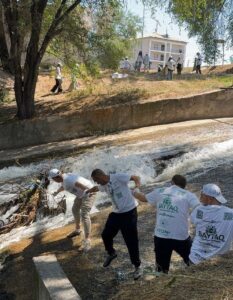
The Baytaq party organized a cleanup campaign along the Shamalgan River in the Almaty Region. Photo credit: baytaq.kz
The Baytaq organized a cleanup campaign along the Shamalgan River in the Almaty Region and launched the Green LRT Branch campaign in Astana to promote environmentally friendly public transportation.
On July 28, World Nature Conservation Day, the party held a Car-Free Day, encouraging members to avoid private vehicles in favor of public transportation, the LRT, bicycles or walking.
On Aug. 2, the party officially launched its Baytaq environmental campaign caravan, beginning its route in the Aral Region.
People’s Party emphasizes historical memory
The People’s Party of Kazakhstan held a public music event in Almaty titled Eternal Classics, where classical music performances accompanied discussions with residents on current issues.
The party also focused on preserving historical memory, signing a cooperation memorandum with the Memorial Zone association to support search expeditions, archival research and patriotic education projects. Party representatives said preserving the memory of previous generations remains an important element of civic and patriotic education.
NSDP campaigns on social policy
The party continued focusing its campaign on vulnerable groups. Its representatives met with mothers raising children with chronic illnesses, including diabetes and celiac disease, in Uralsk; visited the Ulytau Meirimi support center for people with disabilities and a nursing home in Zhezkazgan; and met parents of children with disabilities in Pavlodar to present proposals supporting inclusive families.
The party’s campaign emphasized social welfare, including support for the inclusive community, the abolition of the compulsory social health insurance system, housing programs and pension reform.
NSDP also held a conference in Astana titled Problems of Modern Education, where participants discussed teacher shortages in special education, the disconnect between education and labor market needs, and transparency in science funding.
Respublica stresses regional development
The Respublica party held a supporters’ forum in Zhezkazgan, where participants discussed industrial development, road infrastructure, healthcare and education.
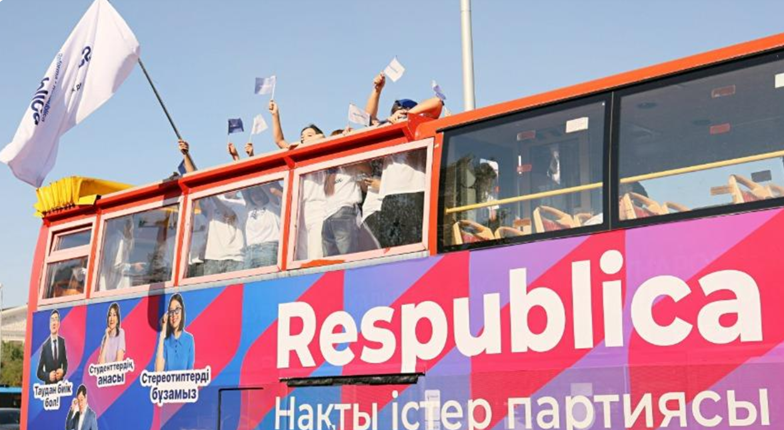
ReBus – Respublica party’s information and entertainment project. Photo credit: respublica-partiyasy.kz
Party representatives visited enterprises in Zhezkazgan, Satpayev and the village of Kengir, meeting with workers to discuss increasing the share of small businesses in the regional economy and improving interregional freight transportation.
During campaign meetings, candidates also addressed regional challenges involving roads, healthcare, industry and education.
The discussion also featured criticism of the People’s Party of Kazakhstan for its proposal to impose penalties on schools with low PISA scores.
Respublica candidate Nurgul Tau argued that penalizing teachers would fail to address structural inequalities between rural and urban schools. Instead, she called for creating equal educational opportunities.
