
ALMATY – Kazakhstan has unveiled a new phase of its transport infrastructure strategy, launching construction of the Beineu–Saksaulsk highway and announcing the expansion of two additional road corridors as part of a broader effort to reposition the country as a key logistics hub linking Europe and Asia.
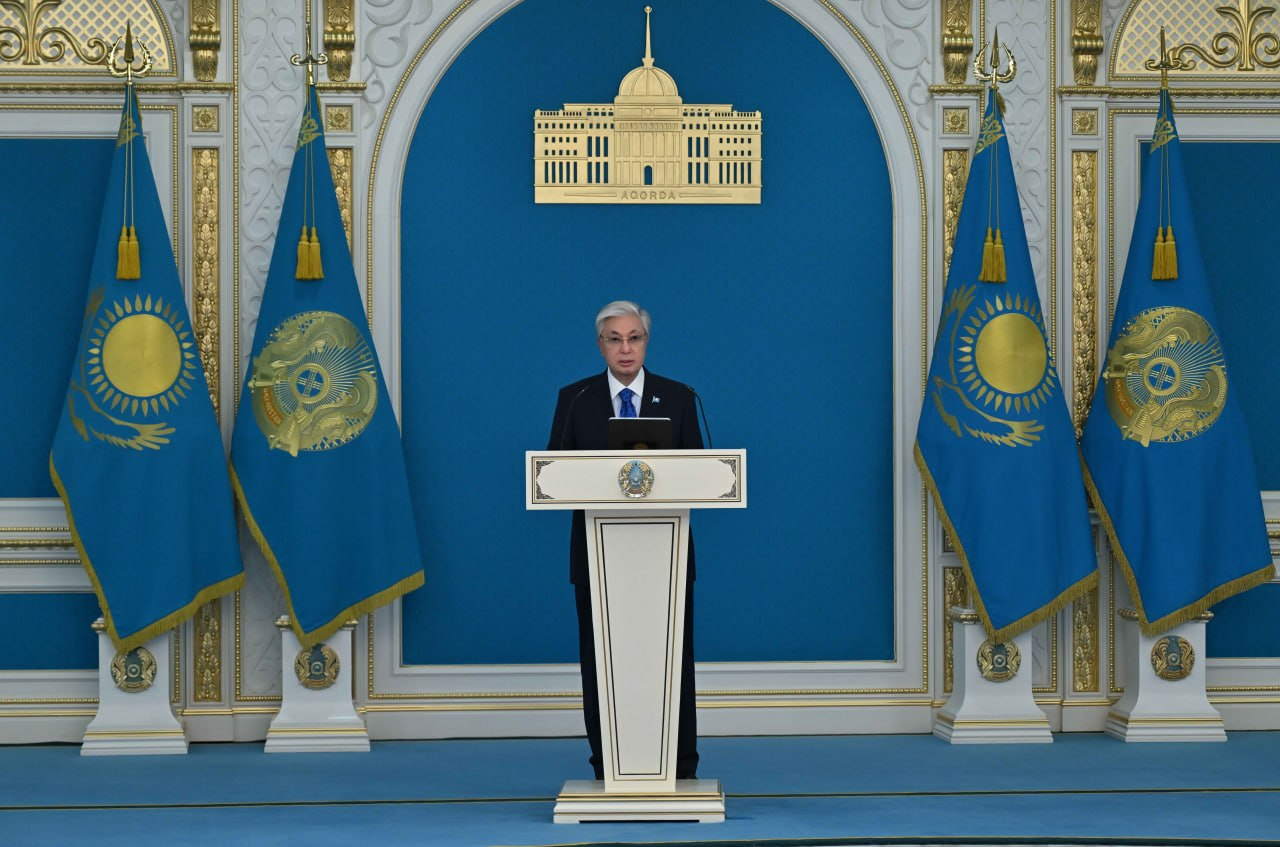
President Tokayev spoke at an Aug. 3 teleconference dedicated to the construction of the Kyzylorda-Saksaulsk, Ulgaysyn-Saksaulsk, and Beineu-Saksaulsk highways. Photo credit: Akorda.
Speaking at an Aug. 3 ceremony, President Kassym-Jomart Tokayev said the projects are designed not only to improve domestic connectivity but also to increase transit capacity, shorten cargo routes between China and Europe, and strengthen Kazakhstan’s role in Eurasian supply chains.
According to him, Kazakhstan’s long-term objective extends beyond building roads to creating an integrated transport network capable of supporting growing Eurasian trade flows.
“Our main goal is to transform Kazakhstan into one of the leading logistics hubs connecting Europe and Asia,” Tokayev said.
The new highway, which President Tokayev proposed naming the Aral-Caspian Highway, will directly connect border checkpoints with China to the Caspian ports of Aktau and Kuryk, reducing freight routes between China and Europe by nearly 1,000 kilometers and shortening delivery times by up to three days.
Moving beyond traditional transport routes
The announcement reflects a broader shift in Kazakhstan’s transport strategy. The latest projects aim to complement old networks with new East-West corridors that align with growing trade between China, Central Asia, the Caspian region and Europe.
In parallel with the Beineu–Saksaulsk project, Tokayev announced the expansion and reconstruction of the Kyzylorda–Saksaulsk and Ulgaysyn–Saksaulsk highways, covering a combined 774 kilometers.
According to him, domestic companies will lead construction, creating more than 10,000 jobs, while annual freight volumes along the corridor are expected to increase 2.5-fold to 13.2 million tons after completion.
“Undoubtedly, these projects will contribute to the development of the national economy and tourism, as well as to improving the welfare of the population. Each of these projects is seamlessly integrated into the transportation system of Kazakhstan. The historically established vertical transportation networks are now complemented by horizontal connections,” Tokayev said, instructing that all projects should be completed no later than 2029.
Building a logistics economy
The road projects form part of a wider effort to transform transport into one of Kazakhstan’s principal growth sectors. According to Tokayev, freight transportation reached nearly 37 million tons in 2025, a 6% increase from the previous year.
Road transport has become one of the fastest-growing segments of the sector. Cargo volumes transported by road have doubled over the past five years, while revenues reached 1.5 trillion tenge (US$2.9 billion) last year, approaching the scale of Kazakhstan’s traditionally dominant railway sector.
In addition, Kazakhstan currently sits on eight international transport corridors, with approximately 35,000 vehicles crossing them every day. The country’s infrastructure expansion has accelerated accordingly. In 2025, authorities built or rehabilitated 13,000 kilometers of roads, with 6,000 kilometers already commissioned. Customs checkpoints along international highways are also scheduled to undergo full reconstruction by 2027, marking the first comprehensive modernization of border road crossings since independence.
Rail development is advancing simultaneously. Construction of the Moiynty–Kyzylzhar and Darbaza–Maktaaral railway lines is expected to finish this year, followed by completion of the Bakhty–Ayagoz railway in 2027.
More than roads
Tokayev argued that Kazakhstan’s transport ambitions now extend beyond physical infrastructure. Rather than simply expanding highways, he said the country must build a modern digital transport ecosystem, supported by a forthcoming national program for domestic freight carriers and the local automotive industry.
The combination of new infrastructure, digitalization and logistics services is intended to increase Kazakhstan’s competitiveness as Eurasian supply chains continue to diversify. The key indicators to watch over the coming years will include cargo volumes on the Aral-Caspian corridor, transit times between China and Europe, utilization of the Caspian ports of Aktau and Kuryk, and the modernization of border checkpoints and digital freight systems.
When completed, the new transport corridors would reshape the country’s position within Eurasian logistics, strengthening its role as a transit hub linking China, Central Asia, the Caspian region and European markets.
