
ALMATY – Kazakhstan’s renewable energy strategy is entering a new phase. After a decade of rapidly expanding wind and solar generation, the government is shifting its focus to hydropower as the missing link needed to stabilize an increasingly renewable electricity system.
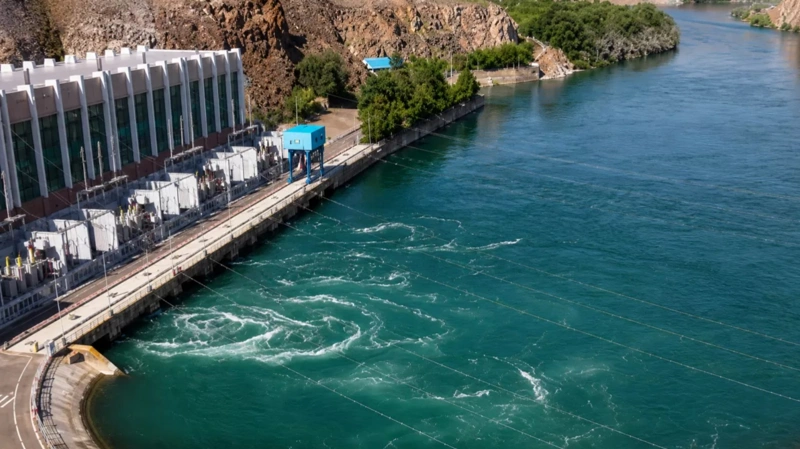
Photo credit: Ministry of Water Resurces and Irrigation.
The shift became clearer on July 31, when the government approved a Hydropower Development Plan through 2035, creating the country’s first long-term framework for identifying new projects, mapping river basins and preparing investment-ready sites. The plan comes as Kazakhstan seeks to diversify its electricity mix while improving grid reliability, an increasingly important challenge as renewable energy capacity grows.
From renewable expansion to system stability
Kazakhstan’s renewable energy policy has produced measurable progress. Renewables generated 6.43% of the country’s electricity in 2024, exceeding the national 2025 target a year early. Installed renewable capacity reached 3.03 gigawatts, including 1.52 GW of wind, 1.22 GW of solar, and 287.7 MW of small hydropower.
At the same time, success has exposed a structural weakness familiar to electricity systems worldwide. Unlike conventional thermal power plants, wind turbines and solar panels generate electricity only when weather conditions allow. As their share in the grid increases, so does the need for flexible generation capable of balancing fluctuations in supply and demand.
This appears to be the problem Kazakhstan is now trying to address. The Hydropower Development Plan outlines 30 measures across six priority areas, including river basin assessments, hydrological studies, environmental evaluations, land preparation and the creation of a national database of potential hydropower sites.
A digital platform will consolidate hydrological, technical and environmental information into a single resource for government agencies and investors. Future project selection will consider water availability, electricity demand, technical feasibility, environmental constraints and investment potential.
Perhaps most importantly, the strategy also introduces planning for pumped-storage hydropower: facilities capable of storing excess electricity generated during periods of low demand and releasing it when consumption peaks, a technology widely regarded as one of the most effective ways of balancing renewable-heavy power systems.
Hydropower moves from supporting role
Although hydropower has long existed within Kazakhstan’s electricity mix, it has remained a relatively modest contributor compared with coal-fired generation and, more recently, wind and solar. The new plan elevates the sector’s role as it targets the commissioning of at least 500 megawatts of new hydropower capacity by 2030, while establishing a longer-term pipeline of conventional hydroelectric plants and storage facilities extending to 2035.
Several projects are already progressing, such as a 16-megawatt hydropower plant on the Kalzhyr River in East Kazakhstan, which is expected to be completed by 2030. Documentation is also underway for a 191.7 billion tenge (US$377.4 million) public-private partnership on the Ugam River that combines a drinking water pipeline with a cascade of hydroelectric stations. The project is expected to supply 110 million cubic meters of drinking water annually while generating 72 megawatt-hours of electricity.
Five larger hydropower stations in East Kazakhstan and the Zhetysu Region with combined capacity exceeding 1,000 megawatts are also being considered for strategic infrastructure status, while authorities have identified 29 hydraulic structures suitable for future small hydropower development.
Taken together, these projects illustrate that the strategy extends beyond individual power plants toward building an integrated hydropower portfolio.
A broader low-carbon strategy
The renewed focus on hydropower does not signal a retreat from wind and solar. Energy Minister Yerlan Akkenzhenov has reaffirmed Kazakhstan’s broader objective of commissioning 8.4 gigawatts of renewable energy capacity by 2035 as part of the country’s low-carbon development strategy at the Baku Energy Week this June.
Instead, the government’s latest plan reflects a subtle but important shift in thinking. The first phase of Kazakhstan’s energy transition centered on increasing renewable generation. The next phase appears to focus on ensuring the electricity system can accommodate that growth without compromising reliability.
As Ainur Sospanova, chairwoman of the Qazaq Green Renewable Energy Association, previously told The Astana Times, the rapid deployment of renewable energy is beginning to expose weaknesses within Kazakhstan’s electricity system. The challenge now is no longer simply adding renewable capacity, but developing the infrastructure necessary to integrate it. Hydropower, particularly pumped-storage facilities, could become one of the principal technologies providing that flexibility.
What comes next
Approving a long-term strategy, however, is only the first step. Hydropower projects typically require years of environmental assessments, hydrological studies, engineering work and financing negotiations before construction begins. Water availability, particularly in transboundary river basins, will remain a critical factor as climate variability places additional pressure on regional water resources.
For that reason, the success of the new strategy will likely be measured less by the number of plans approved than by whether Kazakhstan can convert them into viable projects. The indicators worth following over the coming years include the completion of the national hydrological database, the launch of bankable investment projects, the attraction of private capital and, perhaps most significantly, progress toward Kazakhstan’s first large-scale pumped-storage hydropower facility.
If those milestones are achieved, hydropower could become the technology that enables Kazakhstan’s next stage of decarbonization, transforming renewable expansion from a question of generation capacity into one of long-term system resilience.
