
ASTANA – Director and Partner of Slovenian engineering company RIKO Janez Škrabec has been coming to this part of the world for nearly four decades. His first visit to the Soviet Union was in 1988, when Kazakhstan belonged to a completely different political and economic reality. Today, he is returning to Astana, which is increasingly positioning itself as a regional center of transport, energy, investment and technological cooperation.
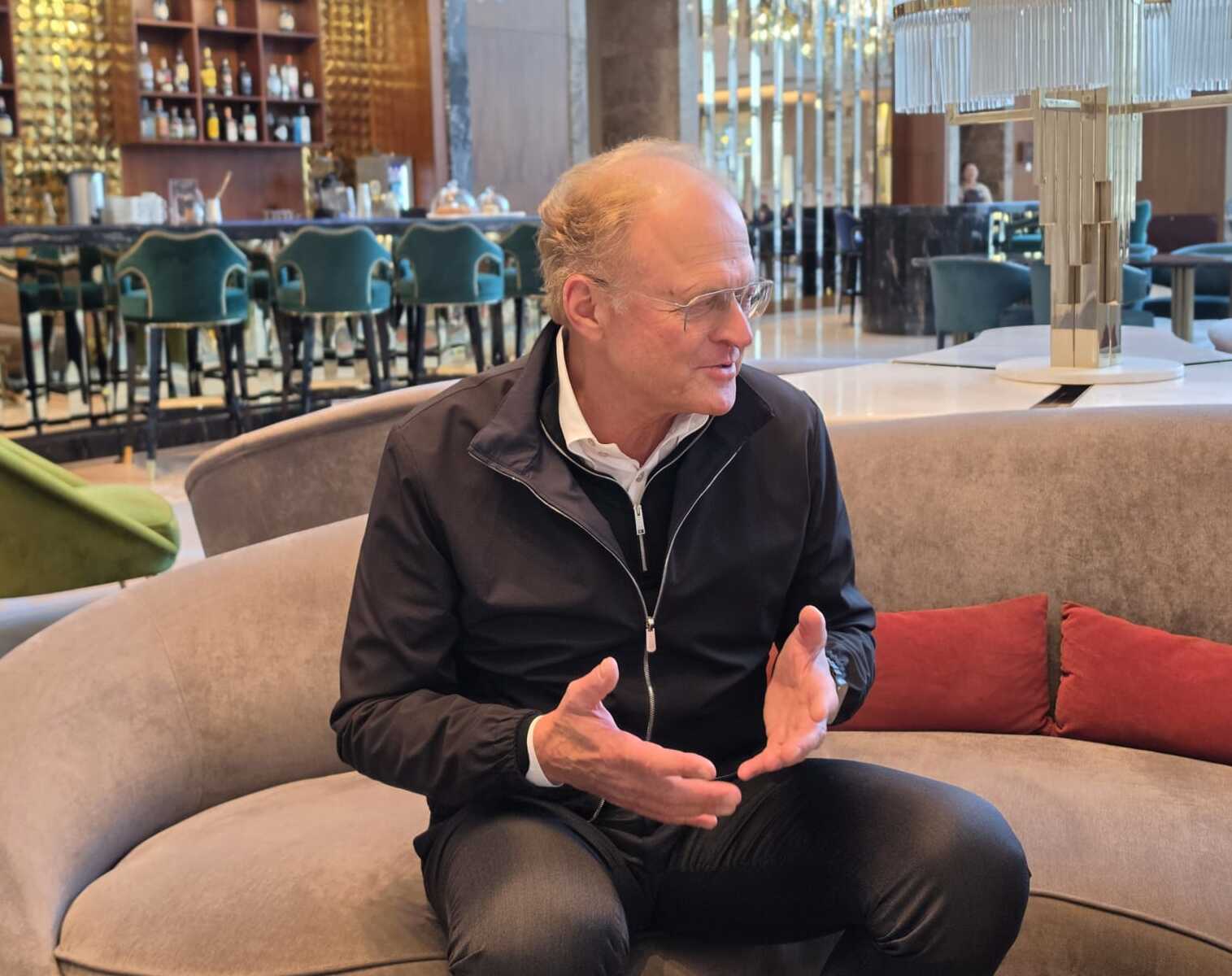
Director and Partner of Slovenian engineering company RIKO Janez Škrabec . Photo credit: The Astana Times
There is a certain value in seeing a country not at one particular moment, but across decades. Škrabec’s perspective is therefore more than that of a businessman assessing a market. He has watched the region change, institutions evolve, and Eurasia’s geography take on new economic meaning.
His visit to Kazakhstan comes as Kazakhstan-Slovenia ties build on the momentum of Slovenian President Nataša Pirc Musar’s visit in spring 2025, which placed greater emphasis on practical economic cooperation in trade, investment, energy, transport and technology. Škrabec joined the Slovenian business delegation during that visit and attended the business forum in Astana with President Kassym-Jomart Tokayev. For RIKO, the visit became a catalyst: the company has since opened a representative office in Astana and is developing projects in energy, water, transport and industrial infrastructure. The next challenge, in Škrabec’s view, is to turn political goodwill into lasting business partnerships.
In an interview with The Astana Times, Škrabec discussed where business can move faster than politics, why energy and infrastructure may become the foundation of a deeper Kazakhstan-Slovenia partnership, and why lasting economic ties ultimately depend not only on capital and technology but also on trust.
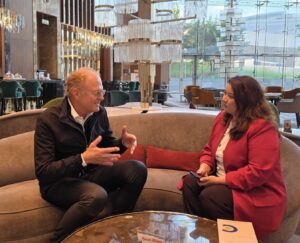
Director and Partner of Slovenian engineering company RIKO Janez Škrabec spoke to The Astana Times correspondent Aida Haidar. Photo credit: The Astana Times
From political momentum to practical cooperation
“High-level political visits matter because they open doors, build trust and create the conditions for companies to move toward concrete projects,” Škrabec said.
For him, however, the real test of political goodwill comes after the official meetings end.
“Business can move faster than politics when there is a clear project, financing, technology and a reliable local partner. At that point, political goodwill can quickly become economic reality,” he said.
The next stage of Kazakhstan-Slovenia cooperation, he believes, should therefore focus less on declarations and more on projects in which the two sides can combine their respective strengths. That view comes from a much longer personal history with the region.
“I first came to the then Soviet Union as a young entrepreneur in 1988, and for decades RIKO was active in Russia, Belarus and Ukraine,” he said.
That experience gives Škrabec a perspective that goes beyond assessing Kazakhstan as a market. He has watched the wider region transform over several decades and has seen Astana itself emerge as one of the most visible symbols of Kazakhstan’s transformation. It is a perspective shaped as much by time as by business and one that helps explain why he sees Kazakhstan’s current trajectory not as a sudden opportunity, but as the latest stage in a much longer transformation.
Energy as a test of long-term partnership
Energy is one area where Škrabec believes this principle can be put into practice.
“Kazakhstan needs not only new generation capacity, but also modernization of transmission and distribution networks, stronger grid reliability, digitalization, integration of renewables and energy-storage solutions,” he said.
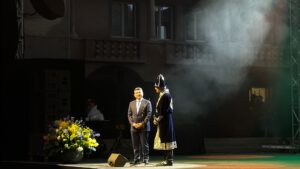
Photo credit: RIKO Janez Škrabec‘s personal archive
He sees opportunities across a broad part of the energy system, including “transformer and traction substations, grid modernization, hydropower, renewables, battery storage and energy efficiency.”
For Slovenian companies, Škrabec believes the opportunity lies in combining specialized engineering with technology integration and project implementation.
“Slovenian companies are strong in specialized engineering, technology integration and project implementation. RIKO, for example, has references in photovoltaics, hydropower, substations and battery energy storage,” he said.
But he also places a strong emphasis on localization, noting that the most sustainable model is not simply to export European solutions to Kazakhstan.
“For us, localization is essential. We want to work with Kazakh engineers, contractors and manufacturers and, where economically justified, develop local production or joint ventures.”
He also sees potential in the European Union’s Global Gateway initiative, “especially where Kazakhstan’s development priorities can be combined with European engineering and financial instruments.” The approach reflects a broader idea running through Škrabec’s thinking: the strongest partnerships create capacity on both sides rather than simply completing individual contracts.
What still holds European investors back
Kazakhstan, in his assessment, has become increasingly interesting to European capital for reasons that extend well beyond raw materials.
“Kazakhstan offers a powerful mix of advantages: natural resources, strategic geography, growing infrastructure and a clear ambition to modernize its industrial and technological base,” Škrabec said.
He believes European investors are increasingly looking at Kazakhstan “not only as a resource market, but as a place for infrastructure, logistics, industry, energy transition and higher-value technology.” For Slovenian companies, another advantage is familiarity with the wider region.
“Many of us have decades of experience in the wider post-Soviet region. We understand technical standards, institutional structures and the organization of large infrastructure projects,” he said.
At the same time, Škrabec is frank about what European investors continue to watch closely.
“European investors still pay close attention to regulatory predictability, procurement transparency, administrative efficiency, investment protection and geopolitical risk,” he said, noting that progress on those fronts could have a direct economic effect.
Beyond trade: building joint capabilities
Škrabec sees the greatest long-term potential in a relationship that goes beyond traditional trade statistics. The strongest model, in his view, is based on complementarity.
“Slovenian companies can bring specialized technology, engineering expertise, project management and access to European know-how and financing. Kazakh companies bring local market knowledge, industrial capacities and strong regional connections,” he said.
That combination, Škrabec said, creates opportunities in “energy, water, railways, logistics, environmental technologies and industrial infrastructure.” There is also a regional dimension. According to him, there is a strong potential for joint ventures, localization and, eventually, expansion into third-country markets across Central Asia. For RIKO, this is particularly relevant because its model integrates technologies, financing and partners into complete project solutions.
Such a model could change the very definition of economic cooperation between Kazakhstan and Slovenia. Instead of asking only what one country can export to the other, businesses can begin to consider what they can build together and where those combined capabilities might travel next.
A Kazakhstan beyond resources
That question becomes even more important when Škrabec looks five to ten years ahead.
“I believe it would be a mistake to see Kazakhstan ten years from now primarily as a supplier of natural resources,” he said.
Resources will remain important, but in his view, the key question is how much value Kazakhstan can create domestically. He expects continued growth in manufacturing, energy, logistics, transport, digital industries and advanced technologies. The Trans-Caspian International Transport Route will add another layer to that transformation.
“The Trans-Caspian, or Middle Corridor, will also strengthen Kazakhstan’s role as a bridge between Asia and Europe,” Škrabec said.
But even the word “bridge” may ultimately be too narrow.
“The real opportunity is for Kazakhstan to become not only a transit and resource country, but a place where industrial value, technology and expertise are created,” he noted.
That is where he sees the strongest basis for European and Kazakh cooperation: European companies can contribute technology, engineering and investment, and Kazakhstan offers scale, location, resources and regional connectivity. The relationship, therefore, could evolve from a connection between markets into a partnership between capabilities.
The role of trust and of people
For Škrabec, however, economics alone cannot sustain a relationship over decades.
“I would add one more dimension: long-term partnerships are not built only through trade and investment. Culture and trust matter too,” he said.
This is not simply a philosophical observation. RIKO has already supported Kazakh cultural initiatives in Slovenia, including the Astana Opera’s Spartacus performance and an evening of Kazakh culture. The company is also developing an initiative for a memorial to Abai Kunanbayev in Slovenia. These efforts sit alongside a longer tradition of cultural diplomacy.
For the past 26 years, Škrabec’s Lions Club has organized an annual evening in Ljubljana dedicated to one country, presenting its art, cuisine, history, traditions, natural beauty and economy. RIKO has traditionally been the main sponsor. This year, the evening focused on Kazakhstan.
“The event takes place in the Slovenian capital, on one of Ljubljana’s most prestigious stages, and has long been regarded as one of the city’s leading social events,” Škrabec said.
He recalls the response to the Kazakhstan evening as exceptional. He also singled out Kazakhstan’s Ambassador to Slovenia, Altay Abibullayev, whose role went beyond formal diplomatic representation.
“Ambassador Altay Abibullayev proved to be an excellent host. At the end of the evening he presented me with a traditional Kazakh shapan (a coat). I received it as a great honor and a beautiful symbol of friendship between our two countries.” Škrabec said
It is a fitting detail in a relationship that Škrabec increasingly sees as being built on more than economic calculation. A representative office, a tender, a joint venture or a logistics project can create the infrastructure of a partnership. But people create memories.
And perhaps this is where Škrabec’s nearly four decades of experience matter most. He has seen the political map change, economies transform, and Astana grow from a very different place into the capital it is today. His assessment of Kazakhstan’s future is therefore not simply an investor’s forecast. It is also the perspective of someone who has seen how quickly a country can change when its ambitions, geography and institutions begin moving in the same direction.
For Kazakhstan and Slovenia, the next stage may be about turning that accumulated political goodwill into something more permanent: industrial partnerships, shared technologies, new transport links, local capabilities and, ultimately, a relationship in which economic cooperation becomes as natural as diplomatic dialogue.
As Škrabec put it, the most durable foundation is not trade alone, but “that combination of economic interest, cultural understanding and personal trust.”
