
ALMATY – As oil production temporarily softens, Kazakhstan is increasingly relying on construction, manufacturing, transport, trade and agriculture to maintain economic momentum. Government officials argue that strengthening these sectors will not only offset weaker hydrocarbon output in the short term but also lay the foundation for more diversified and resilient long-term growth.
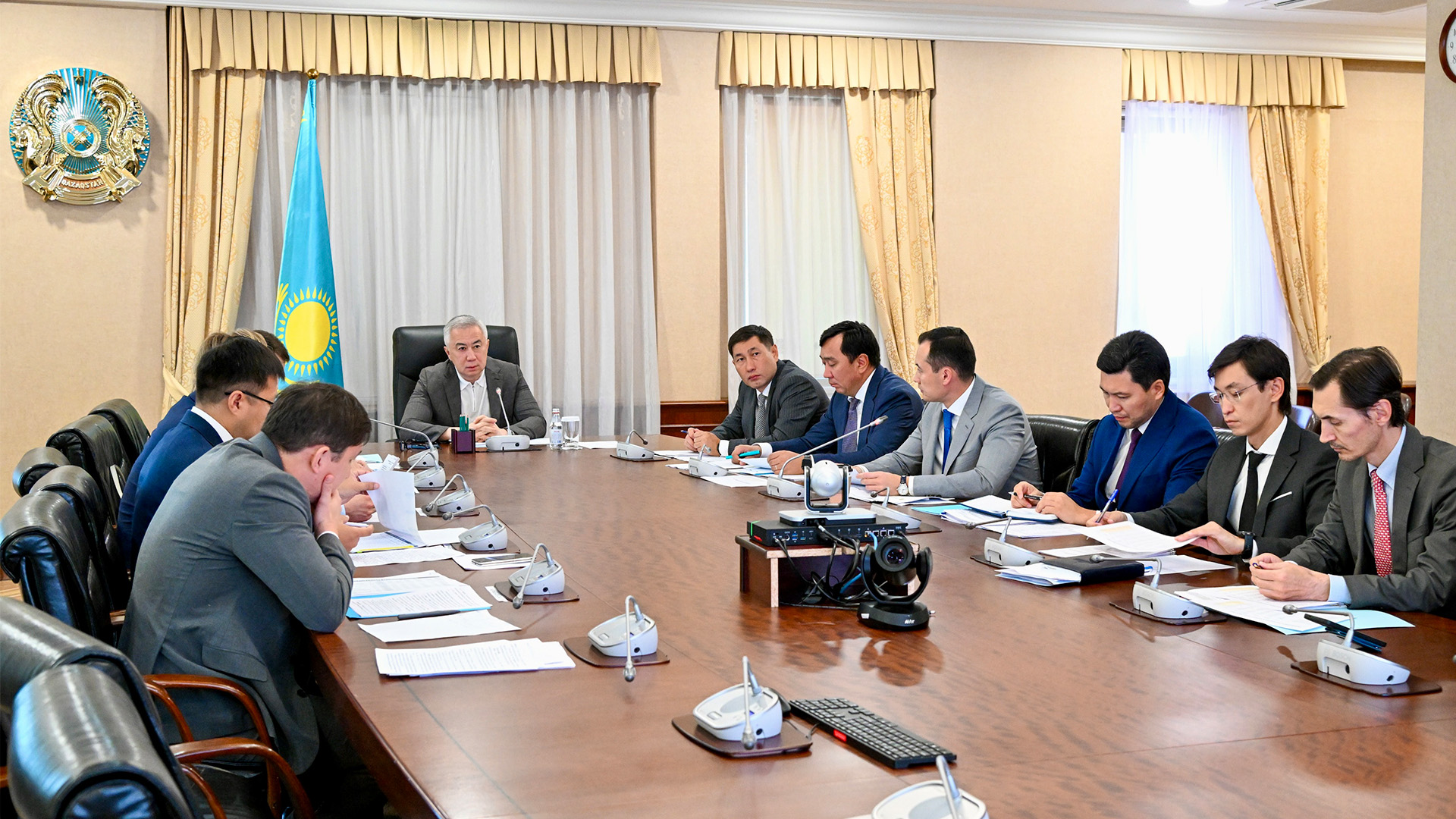
July 27 meeting of the government’s economic growth headquarters, chaired by Deputy Prime Minister and Minister of National Economy Serik Zhumangarin, gathered officials to review the progress across key industries. Photo credit: PM’s press service.
The strategy was at the center of a July 27 meeting of the government’s economic growth headquarters chaired by Deputy Prime Minister and Minister of National Economy Serik Zhumangarin, where officials reviewed progress across key industries and outlined priorities for the remainder of the year.
Shifting the growth model
The government’s emphasis on non-resource industries reflects a broader effort to reduce Kazakhstan’s dependence on hydrocarbons. While oil continues to play a central role in the economy, authorities increasingly view construction, manufacturing, logistics and agriculture as the main engines capable of sustaining growth during periods of lower energy output.

Sobir Kurbanov.
Analysts note, however, that expanding output alone will not be enough to transform the economy. Analyst and policy expert Sobir Kurbanov argued that many regional value chains remain underdeveloped despite their potential.
“Value chains are there, but neither competitive nor complementary,” Kurbanov said, pointing particularly to agriculture and tourism. According to him, fragmented production, weak logistics, inconsistent standards and limited regional coordination continue to prevent Central Asia from developing cross-border industries capable of generating higher-value exports and creating sustainable jobs.
According to Zhumangarin, construction also remains the fastest-growing sector, with officials expecting strong performance through the first seven months of the year. The highest growth is projected in the Ulytau, Abai and Kyzylorda regions, supported by ongoing infrastructure investment.
Manufacturing has also emerged as one of the strongest contributors to economic expansion. Industrial output increased by 9.8%, driven by machinery production, which rose 23.2%, chemicals (19%), food processing (14.7%) and light industry, where production nearly doubled with an 89.2% increase. Authorities expect this momentum to continue in the coming months.
Domestic demand and logistics
Trade has remained another important pillar of growth. Total trade turnover reached 36.2 trillion tenge (US$67 billion), while the physical volume index rose 5.7% during the first half of the year. To sustain this trajectory, regional authorities have been instructed to accelerate the implementation of regional trade development roadmaps, including the launch of new investment projects.
Transport presents a more mixed picture. Although overall freight volumes continue to grow, expansion has been constrained by lower shipments of oil and natural gas. In response, the government plans to place greater emphasis on Kazakhstan’s role as a Eurasian transit corridor by maximizing rail and road transport capacity.
Agriculture’s expanding role
Agriculture is expected to remain another important contributor to economic growth this year, supported by the ongoing harvest campaign, livestock development and record levels of concessional financing for the agricultural sector.
One notable trend is the growing contribution of modern dairy farms financed through preferential lending programs launched in 2024 and 2025. Many of these facilities are now reaching full production capacity, contributing to higher milk output. According to Zhumangarin, during the first half of 2026, Kazakhstan produced 1.9 million tons of milk, a 2.4% increase compared with the same period last year.
Authorities also expect higher production of food and beverages as agricultural output expands.
Infrastructure as a long-term growth driver
Looking beyond short-term economic indicators, Zhumangarin stressed that Kazakhstan’s long-term growth strategy continues to rely on large-scale infrastructure development.
“In this regard, it is necessary to prepare high-quality projects now, which will ensure long-term economic effect and are provided for by the system of regional standards: facilities of healthcare and social sphere, paying special attention to bridges, crossings, key transport highways and energy facilities, funded by the national budget,” he said.
While the government sees infrastructure investment and the expansion of non-oil industries as the foundation for long-term growth, analysts highlight that deeper structural reforms must accompany physical investment.
“Central Asia’s future path of development appeared to be less dependent on geopolitical shifts but more on the internal fundamentals,” Kurbanov said.
He argues that stronger institutions, higher productivity, investment in human capital, climate resilience and practical steps toward regional integration will ultimately determine whether the region can translate today’s economic momentum into sustainable long-term growth.
The approach reflects the government’s broader objective of combining immediate economic stimulus with investments designed to strengthen Kazakhstan’s long-term productive capacity. Rather than relying solely on commodity exports, policymakers increasingly see infrastructure expansion and the development of competitive non-oil industries as essential for sustaining future growth.
