
ASTANA – What began as a series of independent projects has grown into Kazakhstan’s first inclusive digital ecosystem, combining transportation, accessibility and communication services into a single platform designed by and for people with disabilities.

One of the team’s most significant achievements came when one of its projects won the Meta Llama Accelerator Kazakhstan program in 2025. Photo credit: astanahub.com
Developed by Pavlodar-based university students Stanislav Kirichenko and Islam Kulenov, Involve aims to simplify everyday life through digital solutions that address challenges often overlooked by mainstream technology. The platform brings together services ranging from an accessible taxi booking application and an interactive accessibility map to interface customization tools and AI-powered communication features.
For Kirichenko, the project is deeply personal.

From left to right: Islam Kulenov and Stanislav Kirichenko. Photo credit: Aiman Nakispekova/The Astana Times
A second-year computer science student at Toraighyrov University in Pavlodar, Kirichenko has lived with a first-group disability since childhood. His interest in programming began while he was still in school, eventually leading him to develop digital tools tailored to the needs of people with disabilities. After meeting Kulenov at university, the two combined their ideas and began building a broader ecosystem to make everyday services more accessible.
In an interview with The Astana Times, the developers said the platform grew directly from their own experiences navigating a world that often fails to consider the needs of people with disabilities.
“Our projects grew out of personal experience. I know firsthand the challenges people with disabilities face every day. Digital services are often difficult to use because of overloaded interfaces and poor accessibility. The problem is not always the lack of solutions, but that they are often designed without involving the people who actually use them,” Kirichenko said.
Before launching Involve, Kirichenko had developed several prototypes, including InvLove, an inclusive social networking and dating platform designed specifically for people with disabilities.
Unlike conventional messaging applications, InvLove adapts to users’ individual needs. People with cerebral palsy, for example, can convert speech into clear text, while users with visual impairments or limited hand mobility can customize the interface or navigate the platform using voice commands.
“It is both a messenger and a dating platform where people with disabilities can communicate, meet new people and, if they want, find a partner or simply make friends,” Kirichenko said.
Kulenov said each founder initially worked on separate accessibility projects before realizing they could achieve greater impact by combining them into one integrated platform.
“We decided to unite everything into a single ecosystem. Our goal was to create one place where users could access all the services they need, much like a super app,” he said.
Building practical solutions for everyday challenges
One of the first products to emerge from the Involve ecosystem was HandyApp, a ride-hailing service designed for people with disabilities.
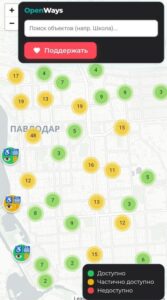
OpenWays project, an interactive accessibility map designed to help people evaluate public buildings before visiting them. Photo credit: Kulenov’s personal archieve
“Every time I needed an accessible taxi, I had to call a dispatcher, explain my route and wait for confirmation. The process was slow and inconvenient. I kept asking myself why ordering an accessible taxi could not be as simple as booking a regular ride,” Kirichenko said.
That question led the team to develop an application that allows users to request accessible transportation directly from their smartphones, without contacting a dispatcher. Users enter their destination and specify any accessibility requirements before being matched with participating transportation providers.
The developers partnered with several local carriers before launching a pilot program in Aksu city in the Pavlodar Region last year. The four-month trial, conducted from April through July, generated about 720 ride requests through the application.
“The pilot showed there was real demand for this type of service. We are now launching the platform in Pavlodar, where interest has also been high,” Kulenov said.
According to the Pavlodar regional administration, more than 30,000 people with disabilities live in the region, including about 4,200 children. More than 6,800 residents receive specialized social services.
Beyond transportation, the team is developing OpenWays, an interactive accessibility map designed to help people evaluate public buildings before visiting them.
Users can select a location on the map to view detailed accessibility information, including the availability of ramps, elevators, tactile paving, accessible restrooms, platform lifts and doorway dimensions.
“A person can check whether a building is actually accessible before leaving home. The application provides practical information about the environment rather than simply indicating a location,” Kulenov said.
Creating such a platform, however, requires extensive fieldwork.
Kirichenko said the team is currently collecting and verifying accessibility data across urban infrastructure, a process he describes as one of the project’s biggest challenges.
Another component of the ecosystem, OpenU, is designed to make websites and mobile applications more accessible by allowing users to customize digital interfaces according to their individual needs.
The software enables users to adjust font size and typography, disable unnecessary images, switch to high-contrast color themes and navigate applications using voice commands. It is also intended to support people with color blindness and other visual impairments through personalized display settings.
“We want users to be able to adapt any interface to their own needs instead of adapting themselves to the technology,” Kirichenko said.
From startup to national initiative
As Involve has expanded, the project has attracted growing support from the country’s technology community, investors and government institutions.
During an April government meeting chaired by Prime Minister Olzhas Bektenov on implementing Kazakhstan’s Inclusive Policy Concept through 2030, officials identified digital accessibility as a priority. Bektenov instructed relevant ministries to introduce a nationwide application for booking accessible taxis, paving the way for broader deployment of services like HandyApp nationwide.
After graduation, they plan to continue expanding the Involve ecosystem, introduce new digital services and eventually enter international markets.
“We want to keep developing products that genuinely improve people’s quality of life. Our goal is to build sustainable partnerships so the products remain accessible to the people who need them most,” Kulenov said.
